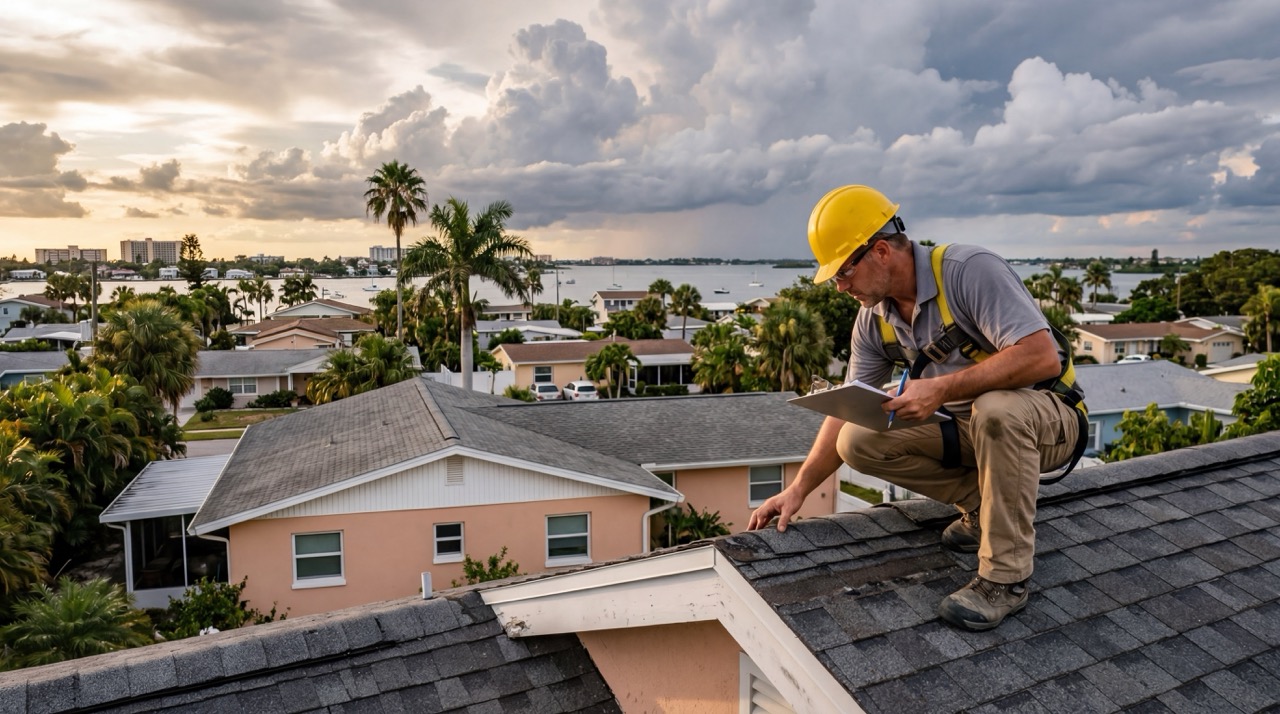
How Do I Prepare My Roof for Hurricane Season in Clearwater?
Start in April or early May — not June. A proper hurricane season roof prep in Clearwater means inspecting your roof for loose shingles, damaged flashing, and weakened fasteners, clearing gutters and trimming overhanging branches, and getting a professional inspection if your roof is more than 10 years old. For Clearwater homeowners on the barrier islands or along the Intracoastal, the stakes are even higher because storm surge and salt air create problems you won't find on mainland roofs.
Table of Contents
- Why Clearwater Roofs Face a Different Kind of Hurricane Risk
- The Pre-Storm Roof Inspection Checklist You Can Do Yourself
- What Requires a Professional Roofer vs What You Can Handle
- Wind Mitigation Inspections: The $75-$150 Investment That Saves Thousands
- My Safe Florida Home Program: Free Inspections and Grants
- Common Clearwater Roof Vulnerabilities Most Homeowners Miss
- What SCM Roofing Recommends
- Frequently Asked Questions
- Key Takeaways
Why Clearwater Roofs Face a Different Kind of Hurricane Risk
Pinellas County is the most densely populated county in Florida, and nearly everything in it is coastal. Clearwater sits on a narrow peninsula with the Gulf of Mexico to the west and Tampa Bay to the east. There's nowhere for storm surge to go except through your neighborhood.
Barrier Island vs Mainland: Two Different Prep Plans
If you live on Clearwater Beach, Sand Key, or Island Estates, your roof deals with year-round salt air exposure that mainland homes in areas like Countryside or Northwood don't face. Salt corrodes metal fasteners, degrades shingle granules faster, and eats through unprotected flashing. Hurricane Helene in September 2024 proved how vulnerable barrier island properties are — storm surge flooded Clearwater Beach businesses and homes, and many roofs that looked fine from the ground had hidden fastener corrosion that failed under wind loads.
Mainland Clearwater homes face a different set of issues. Many were built in the 1980s and 1990s with architectural shingles that are now approaching or past their rated lifespan. These aging roofs may not meet current Florida Building Code wind resistance standards, and that gap is where hurricane damage starts.
The Timing Problem
Once a named storm enters the Gulf, every roofer in Pinellas County is booked. If you wait until June to start thinking about your roof, you're competing with 900,000 other Pinellas residents for the same contractors. The smart window for hurricane roof prep in Clearwater is April through mid-May — before hurricane season officially starts June 1.
The Pre-Storm Roof Inspection Checklist You Can Do Yourself
You don't need to climb on your roof to catch the most common warning signs. Here's what to check from the ground and from inside your attic:
From the Ground (Binoculars Help)
- Missing or lifted shingles — Look for dark patches where shingles have blown off or edges that are curling upward. Even one or two compromised shingles create a wind entry point.
- Granule loss — Check your gutters and downspouts for piles of dark, gritty material. That's your shingles' protective layer washing away, and it accelerates in Clearwater's UV and salt air.
- Damaged flashing — Look at the metal strips around chimneys, skylights, vent pipes, and where the roof meets a wall. If flashing is bent, rusted, or pulling away, water is getting in during heavy rain — and a hurricane will blow it wide open.
- Sagging or uneven roofline — Any visible dip or sag in the ridgeline or eaves suggests structural issues that need immediate professional attention.
- Gutter condition — Gutters should be firmly attached, clear of debris, and draining away from the foundation. Clogged or loose gutters become projectiles in high winds.
From Inside the Attic
- Daylight through the roof deck — If you can see light coming through, water and wind can get through too.
- Water stains or mold — Dark spots on the underside of the roof deck indicate past or active leaks.
- Roof deck attachment — Look at how the plywood is nailed to the trusses. Modern code requires 8d ring-shank nails at 6-inch spacing. Older Clearwater homes often have staples or widely spaced smooth-shank nails that don't meet current standards.
Around the Property
- Overhanging branches — Trim any tree limbs within six feet of your roof. In a hurricane, these become battering rams.
- Loose yard items — Anything not tied down becomes a missile. Patio furniture, grills, and potted plants can punch through roofing materials at 100+ mph.
What Requires a Professional Roofer vs What You Can Handle
DIY-Safe Tasks
Clearing gutters, trimming branches away from the roof, checking attic spaces for visible light or water stains, and removing debris from the roof surface (if safely accessible with a proper ladder) are all things most homeowners can handle. Caulking around small flashings or reattaching a single loose shingle with roofing cement is also within DIY territory.
Call a Licensed Contractor For These
- Flashing repair or replacement — Improper flashing work is one of the top causes of hurricane water intrusion. This requires proper materials and installation technique.
- Shingle replacement beyond a patch — If more than a few shingles are damaged, a contractor needs to assess the underlayment and deck beneath.
- Roof-to-wall connections — The hurricane straps or clips that tie your roof structure to your walls are the most critical wind resistance components on your home. Inspecting and upgrading these requires a licensed professional.
- Structural assessment — Any sagging, soft spots, or suspected wood rot needs a contractor's evaluation.
- Flat roof maintenance — Clearwater condos and homes with flat roof sections (common on Florida room additions and pool enclosure roofs) need professional membrane inspection. Flat roofs pool water differently and have unique failure points.
Wind Mitigation Inspections: The $75-$150 Investment That Saves Thousands
A wind mitigation inspection documents seven specific features of your roof and home that determine how well it will perform in a hurricane. In Clearwater, this inspection typically costs $75–$150 and takes about 30–45 minutes.
What Gets Inspected
The inspector evaluates your roof covering type, roof deck attachment method, roof-to-wall connections, roof geometry (hip vs gable — hip roofs perform better), secondary water resistance, window and door protection, and the overall building code year your home was built or re-roofed to.
The Insurance Payoff
Wind mitigation discounts in Florida can reduce the windstorm portion of your homeowners premium by 20–45%. For Clearwater homeowners, where the windstorm premium often makes up 50–70% of the total insurance cost, that translates to real savings — typically $400–$2,000 per year depending on your home and current features. The inspection is valid for five years, so at $75–$150, the return on investment is massive.
When to Get One
If you've never had a wind mitigation inspection, get one now. If you had one done more than five years ago, it's expired and you need a new one. If you've made improvements since your last inspection — new roof, hurricane shutters, impact windows — get a new one to capture those upgrades as discounts.
My Safe Florida Home Program: Free Inspections and Grants
The My Safe Florida Home program is a state-funded initiative that provides free wind mitigation inspections and matching grants up to $10,000 for hurricane hardening improvements. For the 2025–2026 fiscal year, the Florida Legislature allocated $280 million statewide.
How It Works
The state provides a free wind mitigation inspection by a qualified inspector. Based on the results, you receive a list of recommended improvements. If you qualify for the grant, the state matches $2 for every $1 you spend on approved improvements, up to $10,000 total.
What's Covered
Eligible projects include roof deck attachment upgrades (re-nailing to current code), secondary water resistance barriers, roof covering upgrades, roof-to-wall connection improvements, opening protection (hurricane shutters or impact windows), and garage door reinforcement.
How Clearwater Homeowners Apply
Visit MySafeFLHome.com and create an account. Complete the prioritization questionnaire — this determines which group you fall into. Applications are first-come, first-served within each priority group, so apply early. Demand has been extremely high since the portal reopened in August 2025, so don't wait.
Common Clearwater Roof Vulnerabilities Most Homeowners Miss
Aging 1990s Shingle Roofs
A huge portion of Clearwater's housing stock was built or re-roofed in the 1990s. Those 25-to-35-year-old shingles are past their rated lifespan, and Florida's UV exposure and humidity accelerate deterioration. Shingles that look okay from the street may have lost most of their wind resistance.
Salt Air Corrosion on Barrier Island Properties
Homes on Clearwater Beach, Sand Key, and Island Estates face accelerated corrosion on every metal component — nails, screws, flashing, drip edge, and roof vents. Standard galvanized fasteners can fail in 10–15 years in salt air environments. Stainless steel or properly coated fasteners are the standard for coastal Clearwater properties.
Condo and HOA Flat Roof Maintenance
Clearwater has a high concentration of condominiums and townhome communities, many with flat or low-slope roof sections. Flat roof membranes require different maintenance than pitched roofs — they need regular inspection for ponding water, membrane blistering, and seam separation. HOA boards that defer this maintenance are setting up the building for catastrophic failure in a hurricane.
The Underlayment Problem
Even when shingles or tiles appear intact from the outside, the underlayment beneath them has a shorter lifespan. In Clearwater's heat and humidity, standard felt underlayment can degrade in 15–20 years. Modern synthetic underlayment lasts longer, but many Clearwater homes still have the original felt paper from their last re-roof. When the underlayment fails, every shingle or tile lost in a storm becomes a direct path for water into your home.
What SCM Roofing Recommends
Here's our honest take after 25-plus years of working on roofs across Pinellas County: the homeowners who survive hurricane season with the least damage and the fewest insurance headaches are the ones who prepare in the spring — not the ones scrambling in June.
We tell every Clearwater homeowner the same thing. Get on a schedule. Have your roof inspected by a licensed contractor every year, ideally in April. Keep a record of every inspection, repair, and maintenance task. If your roof is over 15 years old, have an honest conversation about its remaining useful life and whether repair or replacement makes more financial sense before a storm forces the decision for you.
As a GAF Master Elite certified contractor, SCM Roofing sees roofs across Clearwater and Pinellas County every day — barrier island condos, mainland ranch homes, and everything in between. We know which neighborhoods have salt air issues, which building eras have weak roof-to-wall connections, and which roof types need extra attention before hurricane season. A free estimate from our team gives you a clear picture of where you stand.
---
Frequently Asked Questions
Q: When should I start preparing my roof for hurricane season in Clearwater?
A: Start in April or early May — well before the June 1 official start of hurricane season. This gives you time to schedule a professional inspection, complete any repairs, and order materials if needed. Once a storm enters the Gulf, every roofing contractor in Pinellas County is fully booked, so early preparation is critical in Clearwater.
Q: How much does a wind mitigation inspection cost in Clearwater, and how much can I save on insurance?
A: A wind mitigation inspection in Clearwater typically costs $75–$150 and is valid for five years. Most Clearwater homeowners save 20–45% on the windstorm portion of their insurance premium, which often translates to $400–$2,000 per year in savings. The inspection pays for itself within the first few months.
Q: What are the biggest roof vulnerabilities for Clearwater Beach and Sand Key homes?
A: Salt air corrosion is the biggest hidden threat for barrier island properties in Clearwater. Salt degrades metal fasteners, flashing, and roof vents faster than on mainland homes. Many Clearwater Beach homes have standard galvanized fasteners that corrode in 10–15 years in salt air. Additionally, storm surge and wind-driven rain create different damage patterns than mainland homes experience.
Q: Can I prepare my Clearwater roof for hurricane season myself, or do I need a professional?
A: You can handle basic prep yourself — clearing gutters, trimming branches within six feet of the roof, checking the attic for daylight or water stains, and securing loose yard items. However, flashing repair, shingle replacement beyond a small patch, roof-to-wall connection inspection, and structural assessment all require a licensed Florida roofing contractor. For Clearwater homes over 15 years old, a professional inspection before hurricane season is strongly recommended.
Q: What is the My Safe Florida Home program and how do Clearwater homeowners apply?
A: My Safe Florida Home is a state program that provides free wind mitigation inspections and matching grants up to $10,000 for hurricane hardening improvements. The state matches $2 for every $1 you spend on approved upgrades like roof improvements, secondary water barriers, and impact-resistant openings. Clearwater homeowners can apply at MySafeFLHome.com. Funding is first-come, first-served with $280 million allocated for 2025–2026, so apply early.
Q: How do I know if my Clearwater roof is too old to survive a hurricane?
A: Age alone doesn't determine whether your roof will survive a hurricane — condition matters more. However, if your Clearwater roof is over 20 years old with asphalt shingles, or over 25 years old with tile, it's likely past its rated wind resistance lifespan in Florida's climate. Signs of concern include granule loss in gutters, curling or cracked shingles, rusted flashing, and any history of leaks. SCM Roofing provides free roof assessments across Pinellas County — call 855-SCM-ROOF to find out where your roof stands before hurricane season.
Q: Do Clearwater condos and HOAs need different hurricane roof preparation than single-family homes?
A: Yes. Many Clearwater condos have flat or low-slope roof sections that require different maintenance — specifically inspection for ponding water, membrane blistering, and seam separation. HOA boards should schedule professional roof inspections in the spring and budget for preventive maintenance rather than waiting for storm damage. Individual condo owners should ask their HOA about the building's roof inspection schedule and last maintenance date.
---
Key Takeaways
- Start hurricane roof prep in April or early May in Clearwater — once a storm enters the Gulf, every roofer in Pinellas County is booked solid.
- Barrier island homes on Clearwater Beach and Sand Key face salt air corrosion that mainland properties don't — check metal fasteners, flashing, and vents for corrosion annually.
- A wind mitigation inspection ($75–$150) can save Clearwater homeowners $400–$2,000 per year on insurance and is valid for five years.
- Apply for My Safe Florida Home grants at MySafeFLHome.com — free inspections and up to $10,000 in matching funds for roof hardening and other hurricane improvements.
---
Need a pre-hurricane season roof inspection in Clearwater? SCM Roofing provides free estimates across Pinellas County. Call us at 855-SCM-ROOF or request an appointment online.